Frequently Asked Questions

Recurring Billing Fundamentals

What is recurring billing?

Recurring billing is an automatic payment model that enables businesses to charge customers at regular intervals—such as monthly, quarterly, or annually—for ongoing access to products or services. This process continues until the customer cancels, upgrades, or downgrades their subscription. It reduces manual invoicing and ensures timely, consistent charges for both businesses and customers.

How does recurring billing work?

Recurring billing works by securely storing a customer's payment information and automatically charging them at a predetermined interval. The process includes customer sign-up, order acceptance, payment processing via a payment gateway, billing at the chosen interval, invoice generation, and subscription management. The system also provides reporting and analytics on key metrics like churn rate, MRR, and customer lifetime value.

What are the main types of recurring billing?

The main types of recurring billing are fixed, variable, and tiered. Fixed billing charges the same amount each cycle, variable billing changes based on usage or quantity, and tiered billing offers different packages or levels with varying features and prices. Examples include SaaS subscriptions, streaming services, and utility bills.

What is the difference between recurring billing and recurring invoicing?

Recurring billing automatically charges customers at regular intervals for ongoing services, while recurring invoicing generates and sends itemized bills for each purchase. Recurring billing streamlines payments, whereas recurring invoicing still requires the customer to pay each invoice manually.

Are subscriptions and recurring billing the same?

Subscriptions refer to the overall model of providing continuous access to products or services for a recurring fee, while recurring billing is the automated process of charging customers at set intervals. They are related but not identical; recurring billing is a key component of subscription models.

Does recurring billing mean automatic payments?

Yes, recurring billing means that payments are automatically charged to the customer's stored payment method at predefined intervals, eliminating the need for manual payment each cycle.

What are monthly recurring bills?

Monthly recurring bills are charges that customers pay every month for ongoing access to a product or service, such as streaming subscriptions or gym memberships.

What does it mean when recurring billing is off?

When recurring billing is off, automated charges are suspended. Customers can still use prepaid services until the end of the billing period, after which the subscription ends unless renewed.

What is the difference between recurring payments and installments?

Recurring payments are ongoing charges at fixed intervals for continuous service, while installments divide a total amount into several scheduled payments, typically for a one-time purchase.

What are recurring expenses also called?

Recurring expenses are also known as fixed or ongoing expenses. These are predictable costs that occur at regular intervals, such as rent, subscription fees, and utilities.

What is the opposite of recurring payments?

The opposite of recurring payments is a non-recurring or one-time payment, where a customer pays once for a product or service without ongoing charges.

Can customers cancel recurring billing?

Yes, customers can cancel or revoke authorization for recurring billing at any time by sending a cancellation request to their service provider via email or phone.

Benefits & Challenges of Recurring Billing

What are the benefits of recurring billing for providers?

Recurring billing offers providers revenue stability, operational efficiency, and opportunities for revenue expansion through cross-sells and upsells. It also streamlines revenue recognition and reduces manual administrative work, enabling better financial forecasting and planning.

What are the benefits of recurring billing for subscribers?

Subscribers benefit from convenience, predictable budgeting, and seamless access to services. Recurring billing automates payments, reduces the risk of service interruption, and often allows for personalized experiences and tailored subscription options.

What challenges are associated with recurring billing?

Common challenges include payment failures, managing proration for upgrades or downgrades, handling customer churn, ensuring payment security, and scaling billing systems as the business grows. Effective recurring billing platforms address these with automated retries, dunning systems, secure payment gateways, and flexible billing structures.

How can businesses handle payment failures in recurring billing?

Businesses can handle payment failures by implementing automated retries, notifying customers of failed attempts, and offering flexible payment options. Setting up a dunning system with escalating reminders and allowing backup payment methods can help recover payments and reduce involuntary churn.

How does recurring billing impact pricing strategy?

Recurring billing enables flexible pricing strategies, such as value-based, tiered, or usage-based pricing. The right pricing strategy can maximize revenue and retention by aligning with customer value perception and market demand. Annual plans often reduce churn, while monthly plans can increase acquisition rates due to lower upfront costs.

Are monthly or annual billings better?

Monthly billing offers flexibility and lower upfront costs, leading to a 13.9% higher acquisition rate. Annual billing provides better retention (9.5% lower churn) and upfront revenue, which can improve cash flow and financial planning. The best option depends on your business goals and customer preferences. Source

Zuora Platform & Product Capabilities

What is Zuora and what does it do?

Zuora is a leading SaaS company that provides a comprehensive subscription management platform. It automates and orchestrates the entire quote-to-cash and revenue recognition process, supporting dynamic monetization, billing, payments, revenue recognition, and analytics for businesses in the Subscription Economy. Source

What products and services does Zuora offer?

Zuora offers a suite of products including Zuora Billing, Zuora Revenue, Zuora Payments, Zuora CPQ, Zephr, Zuora Platform, Zuora Collections, and Accounts Receivable automation. These tools manage the entire subscription lifecycle, from pricing and quoting to billing, payments, revenue recognition, and analytics. Source

What are the key capabilities and benefits of Zuora's platform?

Zuora's platform supports over 50 pricing models, automates billing and revenue recognition, scales to millions of subscribers, enables personalized subscription journeys, ensures global compliance, and provides real-time analytics. Benefits include monetization agility, operational efficiency, improved retention, and faster time to market. Source

What integrations does Zuora support?

Zuora offers over 60 pre-built connectors (including Salesforce, HubSpot, NetSuite, Snowflake), REST and SOAP APIs, warehouse connectors (Databricks, BigQuery, RedShift), 40+ payment gateways (Stripe, GoCardless), Zephr extensions, and a Connect Marketplace with nearly 100 apps. Source

Does Zuora provide APIs for integration?

Yes, Zuora provides REST and SOAP APIs for seamless integration with external systems. The REST API is designed for modern web storefronts, while the SOAP API offers detailed access to billing, payment, and subscription management. Source

What technical documentation is available for Zuora?

Zuora offers extensive technical documentation, including platform docs, developer resources, SDK documentation, integration guides, and payment gateway integration instructions. Resources are available at the Zuora Docs Portal and Developer Center.

Security, Compliance & Support

What security and compliance certifications does Zuora have?

Zuora holds several certifications, including PCI DSS Level 1, SSAE 16 SOC1 Type II, SOC2 Type II, ISO 27001, HHS HIPAA, and SOC 3. These certifications ensure secure handling of payment data, financial reporting, and information security. Source

How does Zuora ensure data security and compliance?

Zuora employs enterprise-grade security measures such as data encryption, role-based access controls, regular audits, and built-in compliance features. The platform supports global compliance, including GDPR, PCI DSS, SOX, and multi-currency tax regulations. Source

How long does it take to implement Zuora?

Implementation timelines vary: focused scopes can be completed in as little as 30 days, typical projects take 30–90 days, and multi-product or multi-entity programs may take several months. Pre-built connectors can enable integrations within one day. Source

What support and training resources does Zuora provide?

Zuora offers 24x5 live global support, email and ticketing, Quick Start Tutorials, Zuora University with 500+ courses, and a Developer Center. Premium support options include Technical Account Managers and Enterprise Solution Architects. Source

Use Cases, Industries & Customer Success

What types of businesses use recurring billing?

Recurring billing is used by SaaS companies, eCommerce and DTC brands, entertainment platforms, education and e-learning providers, health and fitness services, and publications. Examples include Zuora, HubSpot, Netflix, Amazon Prime, and The Wall Street Journal.

Who is the target audience for Zuora?

Zuora targets finance professionals, IT leaders, product managers, operations teams, and sales/customer success teams in industries such as technology, media, healthcare, consumer goods, manufacturing, telecommunications, and entertainment. Source

What industries are represented in Zuora's case studies?

Zuora's case studies cover collaborative work management, communications, consumer goods/retail, corporate services, energy and utilities, finance, healthcare, high tech, home services, HR technology, manufacturing/IoT, media/publishing, OTT/entertainment, software/technology, telecommunications, and video games. Source

Who are some of Zuora's notable customers?

Zuora serves over 1,000 companies worldwide, including Zoom, Box, Zendesk, Asana, The Financial Times, The Guardian, Siemens Healthineers, GoPro, Fender, Schneider Electric, Dell, Ford, Toyota, and General Motors. Source

Can you share specific case studies or success stories of Zuora customers?

Yes, examples include Zoom scaling from 10 million to 300 million users, The Financial Times growing digital subscriptions, Asana reducing SSP analysis time by over 90%, and Hudl saving 100+ hours per month through automation. More case studies are available on Zuora's website. Source

What business impact can customers expect from using Zuora?

Customers can expect recurring revenue growth, operational efficiency, improved retention, faster time-to-market, and global compliance. For example, Swiftpage saw a 140% increase in subscription customers, and Asana closed its books in 4–5 days after implementing Zuora. Source

What feedback have customers given about Zuora's ease of use?

Customers like Mindflash, TripAdvisor, FireHost, Briggs & Stratton, Buildium, and AppFolio have praised Zuora for its flexibility, ease of integration, and ability to reduce manual workloads. For example, TripAdvisor reduced sync times from 5 hours to 5 minutes, and AppFolio improved team morale by easing close cycles. Source

Pain Points & Solutions

What core problems does Zuora solve for businesses?

Zuora solves problems such as slow, manual close cycles, ASC 606/IFRS 15 compliance, scaling usage-based monetization, multi-entity and global compliance, revenue leakage, data quality issues, spreadsheet dependency, quote-to-cash misalignment, and forecasting challenges. Source

What pain points do Zuora customers commonly express?

Customers often mention challenges like manual reconciliations, compliance with accounting standards, scaling hybrid monetization, multi-currency operations, revenue leakage, fragmented data, spreadsheet dependency, quote-to-cash misalignment, and forecasting difficulties. Zuora addresses these with automation, integration, and robust reporting. Source

How does Zuora help with real-time product performance metrics?

Zuora provides real-time metrics on profitability, conversion rates, and discounting rates, enabling businesses to respond quickly to market trends, optimize pricing strategies, and improve sales targeting. Integration between CRM and CPQ tools ensures data visibility for analysis. Source

Why should a customer choose Zuora over other recurring billing solutions?

Zuora offers flexibility with over 50 pricing models, proven scalability (e.g., Zoom's growth), AI-powered personalization, hybrid monetization, audit-ready compliance, and a track record of success with leading brands. These strengths make it suitable for businesses with complex, global, or rapidly scaling subscription needs.

Glossary Hub / Recurring Billing Explained: Key Concepts & Benefits

Recurring Billing Explained: Key Concepts & Benefits

Monochrome image of a stock market graph on a computer screen, showcasing financial data trends.

TL;DR

  • Recurring billing is the automated process of charging customers at regular intervals—such as monthly or annually—for ongoing access to products or services.

  • It’s a foundation of subscription business models, helping companies collect predictable revenue without manual invoicing each cycle.

  • By automating billing, businesses reduce errors, improve cash flow, and enhance the customer experience with timely, consistent charges.

  • Recurring billing also supports flexible pricing structures (like tiered, usage-based, or hybrid plans) that align with customer needs and drive long-term retention.


The subscription economy is booming — and for good reason.

Transitioning from one-time transactional sales to building a subscription model offers various advantages. With this shift, companies can increase recurring revenue opportunities, reduce their administrative load, and turn buyers into lifelong customers.

According to the latest Subscription Economy Index, 64% of consumers feel more connected to companies with a subscription model than to companies where they make one-off purchases.

More and more consumers now prefer the convenience of subscriptions to access the products and services they desire whenever they need them. And they’re willing to pay for this through recurring billing.

But if companies are to make this transition, they need to understand exactly how recurring billing works, how to mitigate potential challenges, and the tools and software that can help optimize their transition.

What is recurring billing?

Recurring billing is an automatic payment model that enables businesses to charge customers’ accounts periodically at a predetermined price for products or services. This interval could be weekly, monthly, quarterly or annually ––or even on a custom schedule.

These charges continue until the customer churns, downgrades or upgrades their account. The latter would follow a new billing agreement. For instance, when a customer upgrades from a basic plan to a premium, the new amount will be based on the premium service’s value.

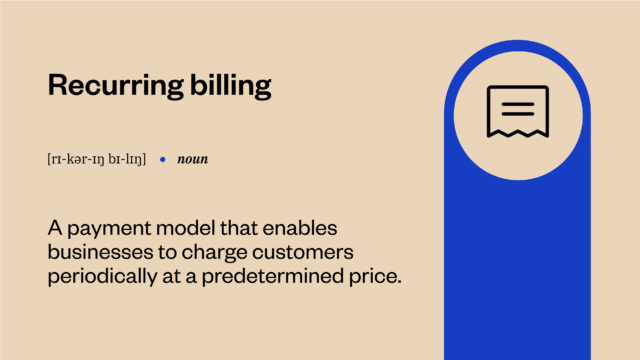
Graphic with definition of recurring billing: a payment model that allows businesses to charge customers periodically at a set price.

To authorize recurring billings, customers must provide their payment information to the service provider. This enables the company to regularly and automatically deduct a specific fee from their account based on the plan that customer has chosen. This method allows businesses to charge each of their customers accurately—and on time.

Recurring payments reduce the need to get customer permission for every charge. It also reduces the administrative load of having to individually send bills or invoices every month.

Types of recurring billing

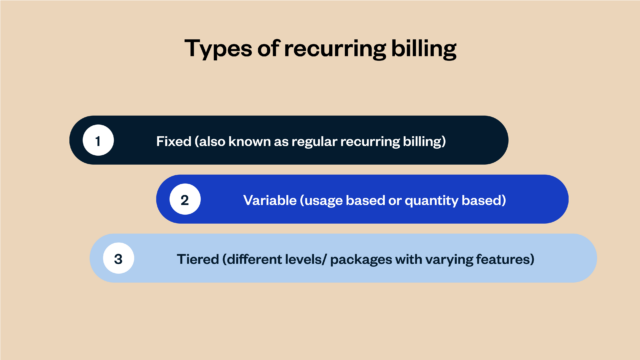
Types of recurring billing: 1. Fixed, 2. Variable (usage or quantity based), 3. Tiered (different levels with varying features).

The types of recurring billings are:

  1. Fixed

  2. Variable

  3. Tiered

Fixed recurring billing

In this model (also known as regular recurring billing), the customer charges a fixed amount for a particular service or subscription in every payment cycle, regardless of usage.

Some businesses that charge customers the same amount at regular intervals include:

  • Companies with a membership fee: Most gyms, fitness centers, and clubs often use this type of billing. They charge customers a fixed monthly or annual fee to keep access to services or a specific location.

  • Streaming services: Popular streaming platforms such as Netflix or Spotify bill customers a fixed monthly fee for uninterrupted access to their vast content libraries.

  • Web hosting services: Web hosting companies like WordPress and BlueHost commonly offer this billing method for hosting plans. Customers regularly pay a predetermined fee to keep their websites live and accessible.

  • Subscription boxes: Subscription box services deliver curated products like beauty items, snacks, or books, and often employ fixed recurring billings. Customers subscribe to receive monthly boxes and pay a fixed amount each month.

Variable recurring billing

Variable or irregular recurring billings are when the fees change at every billing cycle. In this case, the rate could be based on product usage or the number of seats a customer needs.

Variable billing can further be classified into the following:

Usage-based or metered billing: Customers pay based on their usage, often retroactively. Examples include:

  • Cloud computing services: Customers incur costs based on how much computing power, storage, or network bandwidth they’ve used.

  • Telecommunication services: A customer’s bill will depend on how many minutes they used, messages they sent, or data they consumed.

  • Utility bills: Services like internet, gas, or electricity providers bill customers according to service and infrastructure usage.

Quantity-based billing: Customers pay based on the quantity (usually number of good services/products) or volume they purchased. Examples include:

  • E-commerce business: E-commerce vendors charge their customers based on the quantity (usually bulks or offering) they purchased.

  • Subscription boxes with add-ons: Subscription box services may charge customers based on the number of extra items they selected.

  • Shipping and logistics services: Shipping companies usually bill their customers based on the weight or dimension of goods being shipped.

User-based billing: Customers’ payments will depend on the number of “seats” they need from a company. This model is often used by SaaS businesses. Examples include:

  • SaaS subscription: Billing depends on the numbers of users. The  more users, the more expensive it becomes.

Tiered recurring billing

This usually involves different levels (i.e., basic to premium plans) or packages with varying features and pricing levels. The more features subscribers add to their plan, the higher the prices.

  • SaaS subscription: A vast majority (83%) of SaaS businesses use tiered recurring billing. Customers get billed based on the features they want.

What types of businesses use recurring billing?

Businesses are seeing the benefits from recurring billing. It helps them secure accurate payments on time, reduces the need to send invoices every month, and builds trust with customers.

Companies that use recurring billing models include:

  • SaaS: Zuora, HubSpot, Salesforce, and Dropbox.

  • eCommerce & DTC (Direct-to-Consumer): Amazon Prime, Dollar Shave Club, Blue Apron, and BarkBox

  • Entertainment: Hulu, Disney+, Netflix, and Spotify

  • Education and e-learning: Udemy, Coursera, and Masterclass.

  • Health and fitness: Calm and MyFitnessPal

  • Publications: Medium, The EconomistThe Wall Street Journal.

How does recurring billing work?

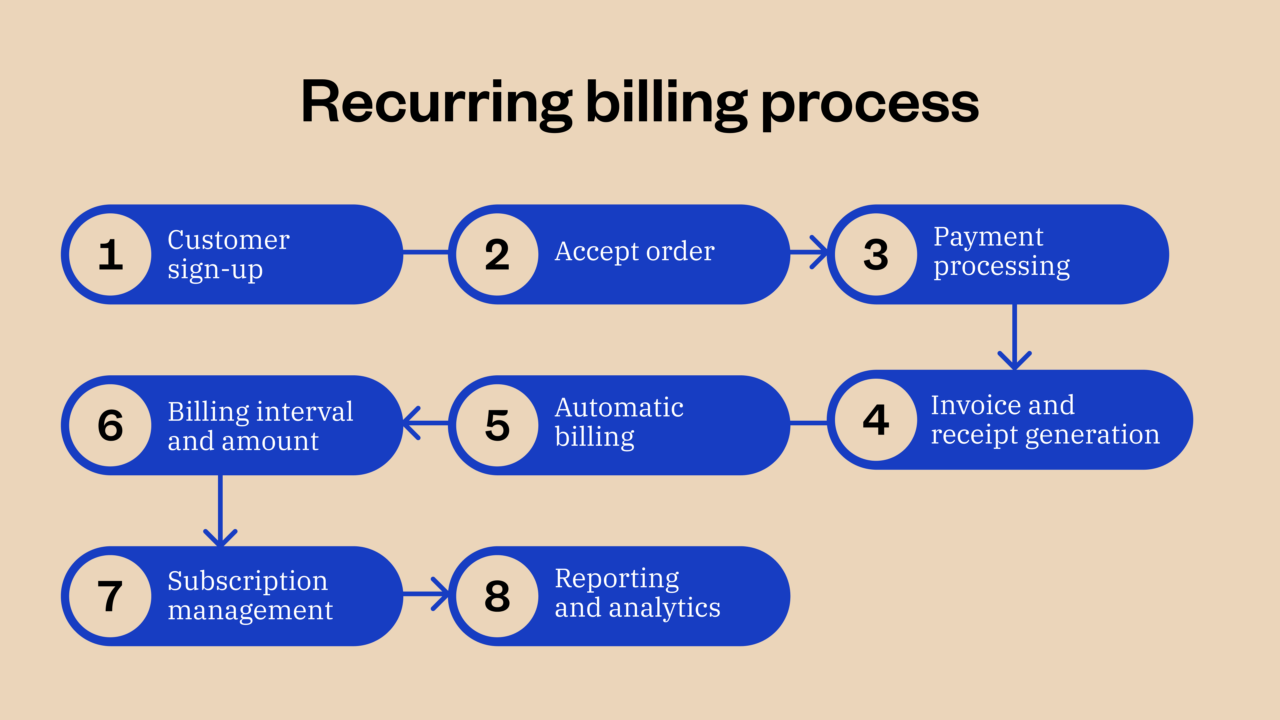
Recurring billing is possible thanks to a few quick steps:

Flowchart of a recurring billing process with eight steps: customer sign-up, order acceptance, payment processing, invoice generation, automatic billing, billing details, subscription management, and reporting.

Customer sign-up

Customers provide payment information, such as a credit card or bank account. The business (or a trusted payment service provider) securely stores this information.

Accept order

Your company’s billing system needs to be able to accept and process customer orders. It will also need to process payments after a customer has chosen which option they want to purchase.

For a subscription-based service, there may be different options based on features, pricing, or duration. Customers will choose which tier they want here.

Payment processing

The recurring billing system securely transmits the payment information to a payment gateway or processor. The processor communicates with the customer’s bank or credit card company to verify the payment method’s validity, then authorizes and processes the payment.

Billing interval and amount

The customer chooses a fitting billing interval (e.g., monthly, quarterly, annually). The system charges according to a specific payment interval based on customer preferences. The billing system should also adjust based on the customer’s chosen tier or features from above.

Automatic billing

Based on the agreed billing interval above, the system sends notifications to customers before each billing cycle to inform them of upcoming charges.

Invoice and receipt generation

After the payment is complete, the recurring billing system generates an invoice or receipt with the transaction details. The customer receives an email with this evidence of payment available for download.

Subscription management

The recurring billing system also handles changes or updates to the customer’s subscription. This includes handling account upgrades, downgrades, cancellations, or changes in billing information. Depending on the system’s capabilities, customers may have self-service options to manage their subscriptions or may need to contact customer support for assistance.

Related guide: The basics of subscriber management

Reporting and analytics

Data is the lifeblood of subscription models—data offers info that companies can use to make informed decisions about future offerings, subscription changes and more. A good recurring billing software solution should track and record transaction data and enable real-time reporting and analytics about your customers and business.

The billing system should provide the following reports:

  1. SaaS metrics: These include essential indicators like churn rate, monthly recurring revenue (MRR), annual recurring revenue (ARR), average revenue per user (ARPU), and customer lifetime value (CLTV).

  2. Subscription analytics: This category encompasses insights such as upgrade/downgrade trends, average subscription length, new subscriptions, total subscriptions, and cohort analyses.

Are monthly or annual billings better?

Choosing the best option between monthly and annual billings depends on customer needs, business goals, and industry conditions. The best subscription plan helps businesses maximize conversion, improve retention, and increase revenue.

Keep an eye on the following insights to consider which might be best:

Customer retention and loyalty

Our data shows the average churn rate is 9.5% lower for annual subscriptions than monthly subscriptions. Customers who opt for annual plans are displaying higher levels of commitment and trust so will likely stay loyal to the brand.

Related guide: How to increase subscriber retention

Revenue predictability and cash flow

With annual plans, you have access to a year’s worth of funds up front, which improves your financial standing. The big lump sum enables businesses to optimize operations, make more strategic decisions, and invest in growth initiatives.

Customer acquisition and price flexibility

Our research indicates monthly plans have a 13.9% higher acquisition rate than annual plans. Cheaper monthly billing means customer acquisition is usually faster than annual billing, since it offers flexible and lower up-front costs.

Discounting and perceived value

Harvard Business Review research shows that consumption is driven by perceived cost, not the actual payment. So when businesses offer annual plans, unlike monthly plans, customers save money due to the discount. They often perceive this as the best value, which drives their commitment to the products or services.

Industry considerations

Your industry could influence your choices around which recurring billing to offer. A monthly subscription is more suitable for a business in an industry with a high churn rate and/or rapidly changing products/services. With a lower up-front cost, there’s a lower barrier to entry for customers.

On the other hand, an annual subscription may be more appropriate in an industry with a high retention rate or long-term commitments.

Regardless of which you consider, the best subscription offering is one that’s designed through the customers’ eyes. Recurring billing should offer them flexibility and a seamless experience.

Benefits of recurring billing for providers

Revenue expansion opportunities

Recurring billing enables businesses to cross-sell and upsell. They can add capabilities and features compatible with what the customers are already paying for, which can expand revenues.

Revenue stability

Recurring billing gives providers a consistent, predictable revenue stream. They can forecast and plan their finances better, knowing they will receive recurring subscription payments.

Operational efficiency

Automating billing reduces manual work (and associated costs) for providers. It streamlines administrative tasks and can help companies allocate resources to other critical business areas.

Streamline revenue recognition

With predictable, consistent income, recurring billing makes revenue recognition easier. It enables a company to recognize its revenue upon the delivery of products and services—which helps to track revenue over time instead of all at once. With recurring billing systems, businesses can automate the billing process and ensure accurate and timely invoicing.

Benefits of recurring billing for subscribers

Convenience and personalization

Recurring billing saves subscribers time and effort, as they don’t need to worry about payment due dates or manual payment processes.

Subscribers enjoy tailored services, such as custom-made subscription boxes or personalized recommendations based on their preferences and previous interactions. This added convenience to customers improves their experience.

Budgeting and predictability

Recurring billing offers subscribers some predictability for when and how much they incur for a particular service. This helps them manage their finances and budget appropriately.

Seamless access

Recurring billing is a win-win for both companies and customers. It’s an easy-to-implement system that doesn’t need extra configuration. Meanwhile, subscribers enjoy uninterrupted access to the product and services they paid for. Also, the system automates the renewal task, which guarantees continuous access.

Challenges in recurring billing—and how to deal with them

Recurring billing has many benefits, but the model is not without its challenges:

Payment failures and handling payment errors

Payment failure is a prominent challenge of recurring billing. It can happen due to insufficient funds, card expiration, misconfigured gateway, or incorrect information.

While this problem is often not an easy fix, a good subscription platform can help you better manage these errors. A reliable, effective system should be able to automatically retry the failed payment method multiple times. It should also automate customer notifications (either through email or other channels) informing them about the failed attempt.

Related guide: Retain subscribers in any economy by taming electronic payments and revenue leakage

Set up a dunning system

Setting up an effective dunning system helps businesses mitigate failed transactions and fight involuntary churn. It sends payment notifications to customers after failed payment attempts.

When a card fails, your payment platform should tell you why it failed. It should also enable you to create flexible payment options, such as allowing customers to set up a backup payment.

Overall, you want to ensure that you create a process with multiple dunning stages with escalating actions (e.g., reminder emails and phone calls) to recover payment.

Payment security

Ensuring payment security is of utmost importance. Protecting customer payment information and preventing unauthorized access or fraudulent activities are crucial for maintaining trust and compliance.

Businesses that use recurring billing systems must consider the following factors to curb fraud and protect their customers:

  • Ensure you adhere to PCI DSS standards for customer card data

  • Use strong encryption and protection protocols while transferring data and during storage

  • Use only a secure, reliable payment gateway

  • Embrace regular audits and assess your security vulnerabilities

  • Keep up with General Data Protection Regulation (GDPR) or the California Consumer Privacy Act (CCPA)

Unscalable billing structure

Due to budget and finding product market fit, businesses often rely on building in-house recurring billing systems. However, as their subscriber base grows and customer demands evolve, the in-house billing solution becomes inefficient. They need a system that can adapt and scale accordingly.

Most market solutions are often built with scalability and flexibility in mind. They are built to handle high-volume transactions, support different pricing models and integrate with other systems seamlessly.

Managing prorations

A reliable recurring billing system must accommodate proration for the customer’s subscription billing cycle. These changes can include upgrades, downgrades, plan changes, or additions/removals of features or services.

Handling changes in subscription levels can be a major bottleneck for any business.

For example, a company that initially had 20 team members may experience significant growth and expand to a team of 80. Depending on their evolving needs, they may need to upgrade or downgrade their subscription plans.

Customer churn and retention

How a business handles recurring billing challenges such as payment errors could be the difference between involuntary churn and strong customer retention. According to one study, 40% of SaaS companies’ churn can be attributed to delinquency (involuntary churn).

To prevent this type of churn, communicate with your customers and offer a great experience.

Be sure to:

  • Identify and verify the payment error

  • Notify the customer via appropriate channels

  • Apologize and take responsibility

  • Resolve the payment error

  • Offer customer support

  • Review and improve your processes

  • Follow up with the customer

Recurring billing and your pricing strategy

By carefully determining the price points for recurring billing, you can both maximize revenue and ensure customer retention.

The right pricing will impact your bottom line regardless of your subscription models. When the price is too high, your customers may churn. Low pricing means you leave money on the table. A well-designed pricing strategy considers market demand, competition, and customer value perception.

Value-based pricing enables you to set the right price based on your customers’ perception.

Related guide: How to accelerate iteration on pricing, bundles, and promotions

Recurring billing FAQs

What is recurring billing vs. recurring invoicing?

Recurring billing automatically charges customers regularly for products and services they subscribe to at a predetermined interval. Recurring invoicing automatically generates and sends an itemized bill or invoice to a customer for a specific purchase.

Are subscriptions and recurring billing the same?

Although the terms “recurring billing” and “subscription billing” have often been used interchangeably, there’s a fine line between them. Subscription billing refers to the overall model of recurring payment for continuous access to a product or services. Meanwhile, recurring billing is an automatic payment process at predefined intervals.

Does recurring billing mean automatic payments?

Yes, recurring billing is an automatic payment charged periodically. A customer subscribes to a product or service with their card details. The billing system securely stores the details, then automatically bills at a predefined interval.

What are monthly recurring bills?

A monthly recurring bill is the amount a subscribed customer pays every month for a service or product.

What does it mean when recurring billing is off?

When recurring billing is turned off, automated charges have been temporarily disabled or suspended. You can still access the prepaid time or services, however, your subscription ends at the renewal period.

What is the difference between recurring payments and installments?

Recurring payments happen continuously and at fixed intervals. Meanwhile, an installment is when a total amount is divided into several smaller payments over a specific period. Though predetermined and scheduled, installments may not be regular and ongoing.

What are recurring expenses also called?

Recurring expenses, also known as fixed or ongoing expenses, are any essential costs a business incurs in its operation. These expenses occur at predictable intervals, such as monthly, quarterly or annually. Examples include rent, subscription fees, and utilities.

What is the opposite of recurring payments?

The opposite of recurring payment is non-recurring or one-time payment. This is where a customer makes a single payment for a product or service via an invoice or bill.

Can customers cancel recurring billing?

Yes, customers can cancel or revoke authorization of their recurring billing at any time. To cancel, simply send a cancellation request to your service provider through email or phone.